Air Freight
Introduction
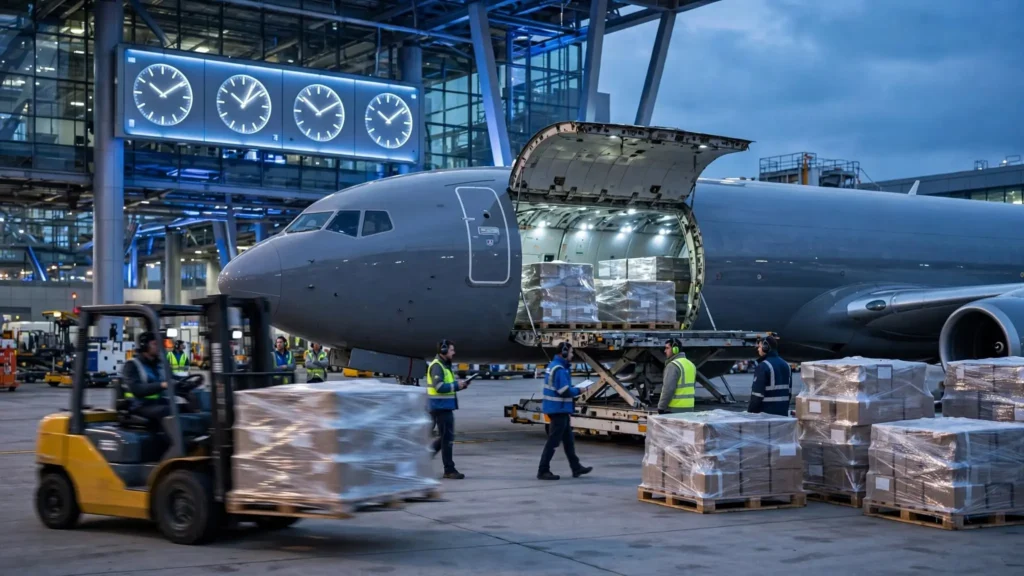
International air freight is designed for shipments where speed, reliability and time-sensitive delivery matter.
But choosing air freight is not simply a matter of finding an airline and paying a rate per kilogram. Your shipment's actual weight, dimensions, cargo type, origin, destination, required documents and handling requirements can all affect the final cost and delivery process.
Whether you are importing your first shipment or regularly moving commercial cargo internationally, this guide will help you understand how air freight works and when it may be the right choice for your shipment. VSN Logistics helps importers and exporters understand their freight requirements before booking.Why Choose Air Freight?
Air freight is generally considered when transit time is more important than achieving the lowest possible transportation cost.
It can be suitable for:
- Time-sensitive shipments
- Smaller and lighter commercial shipments
- High-value goods
- Samples and urgent orders
- Spare parts
- Certain perishable products
- E-commerce and fast-moving inventory
- Shipments where waiting for sea freight may affect the business
Air cargo represents a relatively small share of global trade by volume but a much larger share by value, reflecting the importance of air transport for time-sensitive and higher-value goods.
But remember: Faster does not automatically mean better. If your cargo is large, heavy and not time-sensitive, sea freight may provide a more economical option.
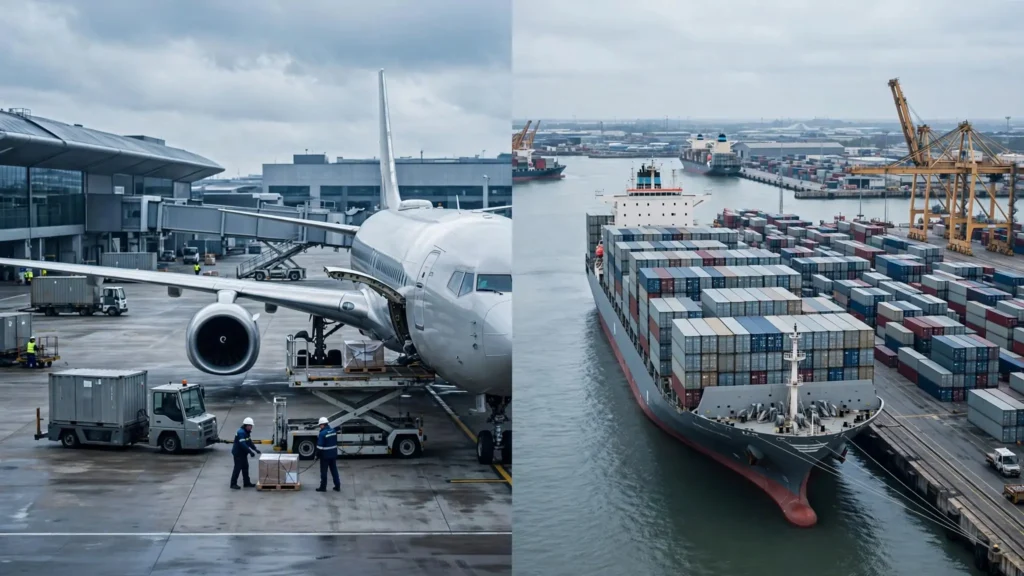
Air Freight vs Sea Freight
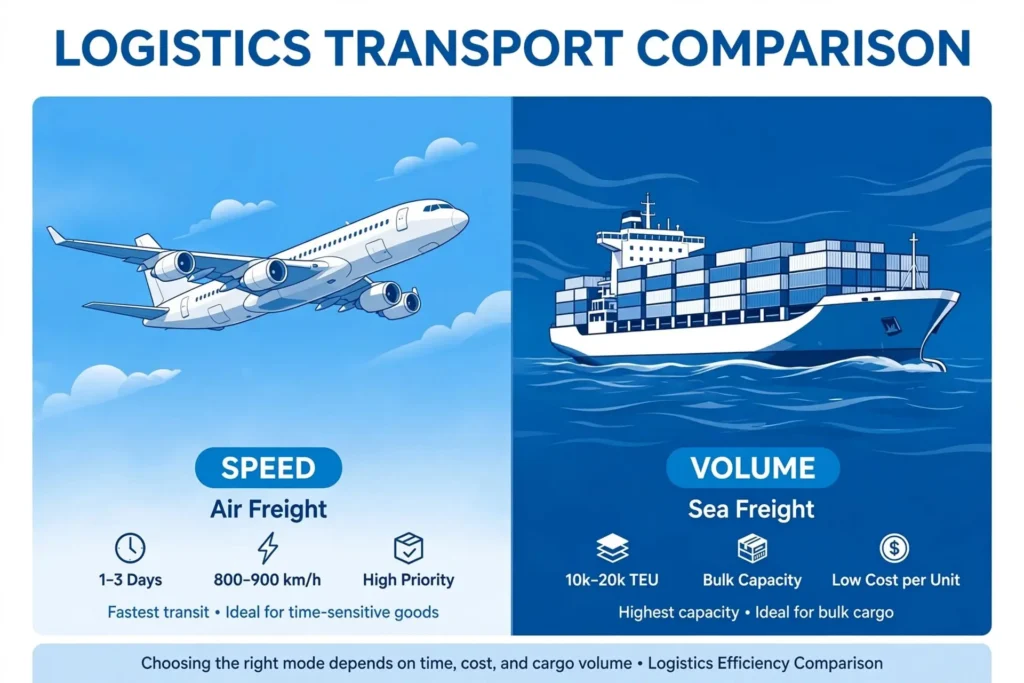
The basic decision is often:
Do I need my cargo faster, or do I need to transport it more economically?
| Factor | Air Freight | Sea Freight |
|---|---|---|
| Speed | Faster | Slower |
| Cost | Generally higher | Generally lower for larger shipments |
| Best suited for | Urgent/time-sensitive cargo | Larger or less time-sensitive cargo |
| Pricing | Weight/chargeable weight + applicable charges | LCL/CBM or container-based + applicable charges |
| Cargo volume | Generally better for smaller shipments | Better suited to larger volumes |
| Typical use | Samples, urgent stock, high-value goods | Bulk commercial shipments |
There is no universal "best" mode. The right choice depends on your cargo, deadline and total landed cost.
How Air Freight Works
An international air freight shipment normally passes through several stages.
1. Cargo Details
The shipper provides:
- Product description
- Quantity
- Number of packages
- Gross weight
- Dimensions
- Origin
- Destination
- Cargo Type
Correct shipment information is important because the cargo must be properly identified, prepared and accepted for carriage.
2. Freight Planning
The freight forwarder evaluates the shipment and considers:
- Available routing
- Airline/carrier options
- Capacity
- Transit Requirement
- Cargo restrictions
- Chargeable weight
3. Freight Quotation
The applicable air freight rate and additional charges are evaluated. The price is not necessarily based only on the weighing scale.
4. Booking
Once the shipment is confirmed, the required capacity is booked with the airline or relevant carrier/consolidator.
5. Cargo Pickup & Handling
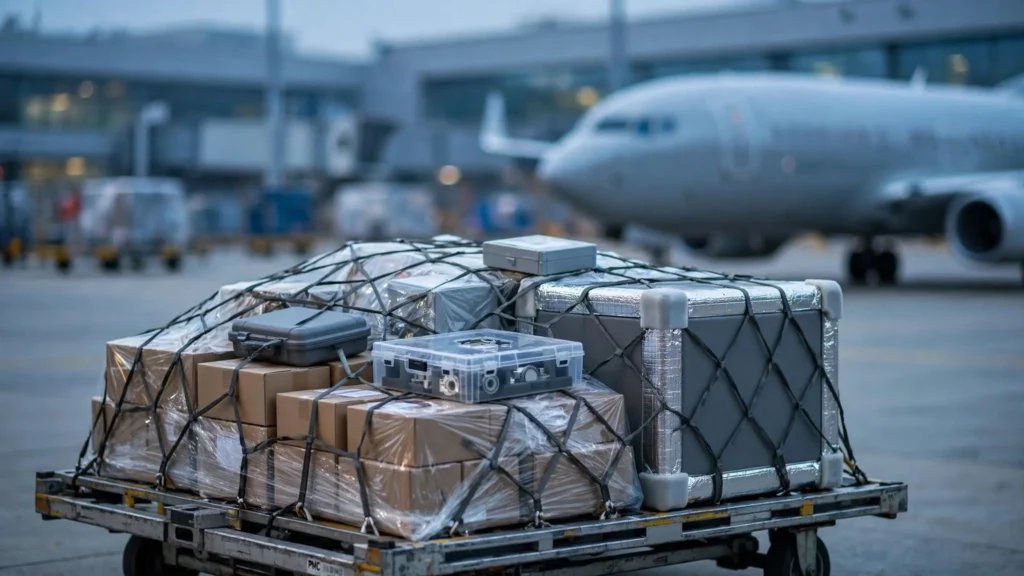
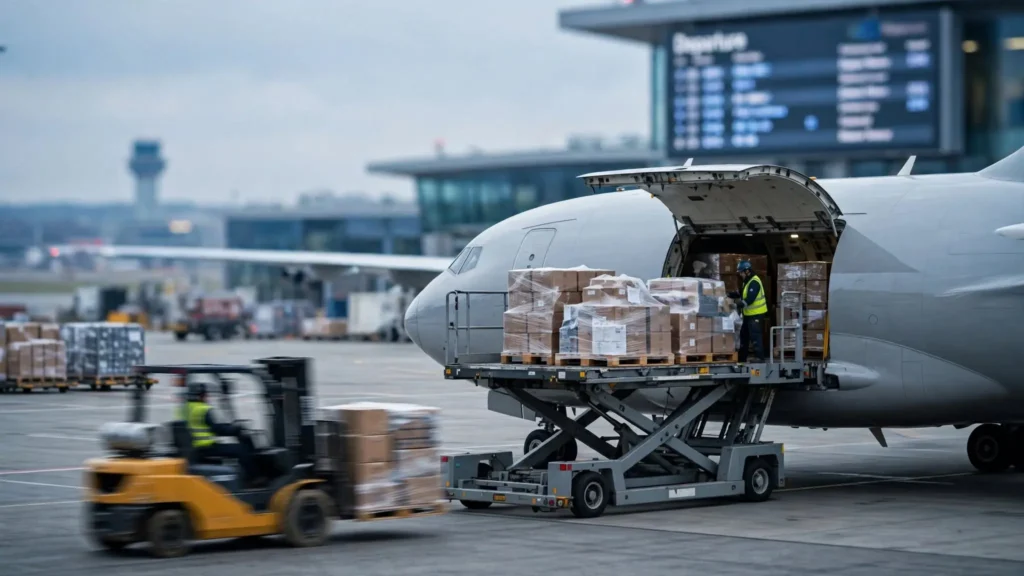
Cargo is collected or delivered to the designated cargo facility, where it is checked, identified, screened and prepared for carriage.
6. Export Documentation & Customs
Required export documentation and customs procedures are completed.
7. Air Transportation
The cargo is transported through the selected air routing to the destination airport.
8. Arrival & Import Clearance
At destination, the shipment is received and processed for import clearance according to the applicable requirements.
9. Delivery
After clearance and completion of applicable destination procedures, the cargo is handed over for final delivery. The air cargo industry follows a detailed chain of handling activities from booking and pickup through carrier acceptance, transport, arrival, handover and delivery.
Air Freight Charges
One of the biggest mistakes new importers make is asking:
"What is the air freight rate per kg?"
The better question is:"What will be the total cost of moving my shipment?"
Air freight pricing can involve several components, including:
- Air freight rate
- Chargeable weight
- Fuel surcharge
- Security/screening charges
- Airport handling
- Documentation charges
- Origin handling
- Destination handling
- Custom clearance
- Delivery charges
- Storage if applicable
- Special handling charges
- Dangerous goods charges, where applicable
The exact charges vary according to the shipment, route, carrier and service.
Actual Weight vs Volumetric Weight
Understanding Chargeable Weight
This is one of the most important concepts in air freight.
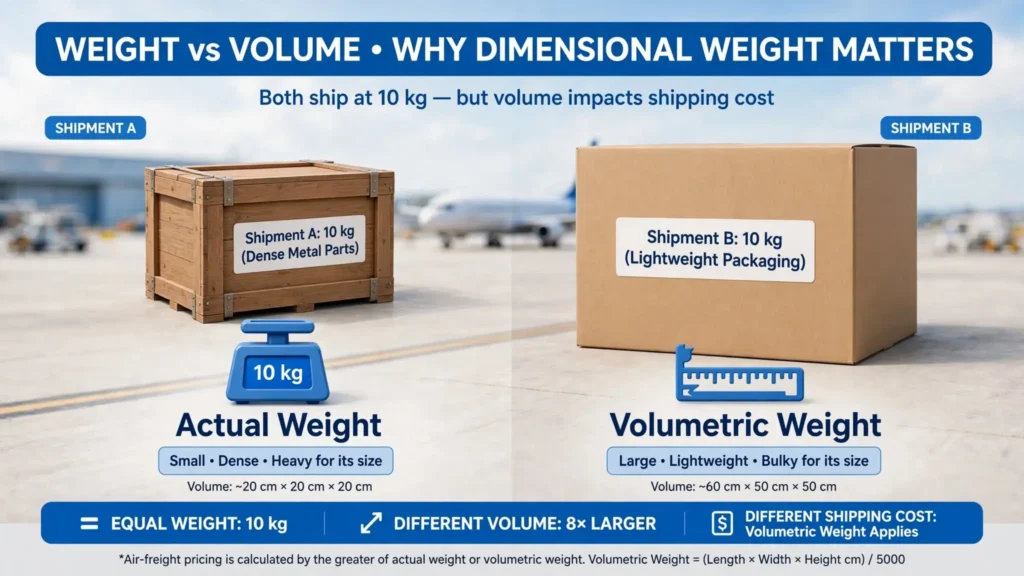
Imagine two shipments:
10 kg of dense metal parts
10 kg of large lightweight packaging
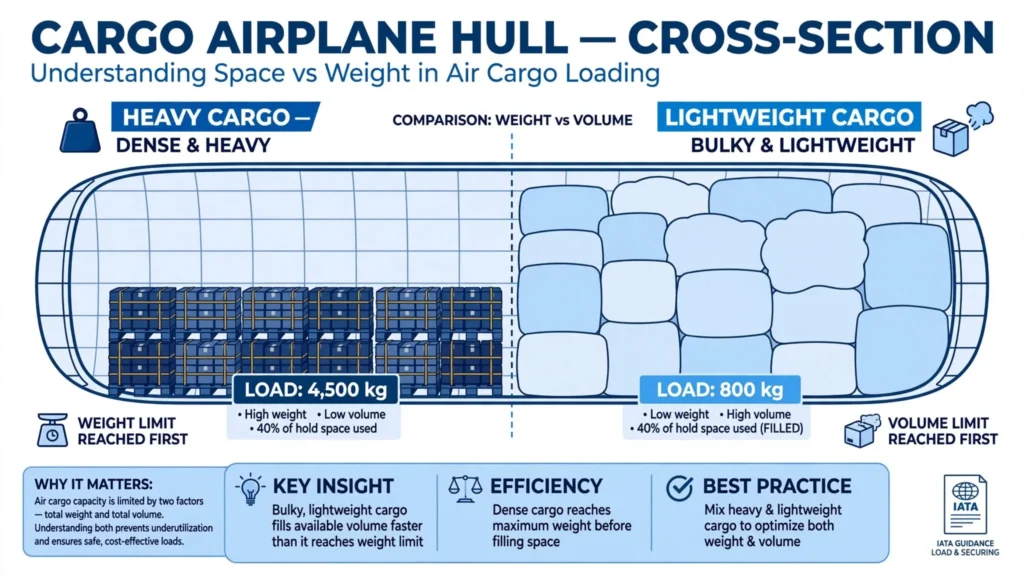
Both weigh 10 kg, but Shipment B occupies considerably more aircraft space.
Therefore, air freight uses volumetric/dimensional weight to account for the space occupied by a shipment.
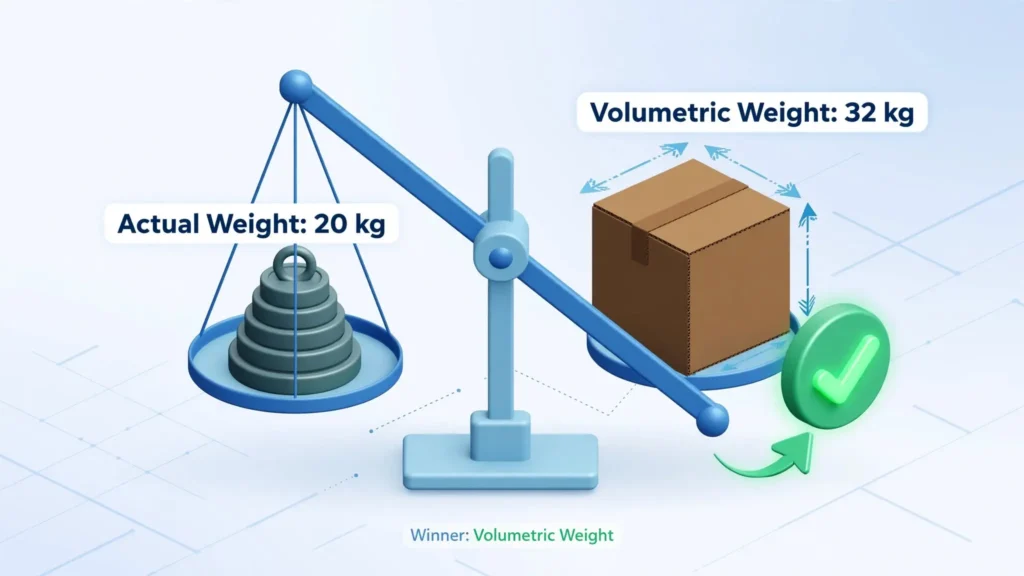
The chargeable weight is generally determined by comparing the actual weight with the applicable volumetric weight, with the higher applicable figure used for rating. IATA explains this principle in its air-cargo tariff guidance.
The shipment may therefore be rated on 32 kg chargeable weight, subject to the applicable carrier/routing rules.
Air Freight Documents
Depending on the shipment, country, product and service, air cargo may involve documents such as:
- Commercial Invoice
- Packing List
- Air Waybill (AWB)
- Purchase Order, where applicable
- Export/import documentation
- Certificate of Origin, where applicable
- Product-specific certificates or permits
- Shipper's Letter of Instruction, where applicable
- Dangerous Goods documentation, where applicable The Air Waybill (AWB) is a key air-cargo document and represents the contract of carriage between the shipper and carrier.
Important
Documents required for your shipment can vary. The product, destination, origin, regulatory requirements and method of shipment should be checked before dispatch.Dangerous Goods
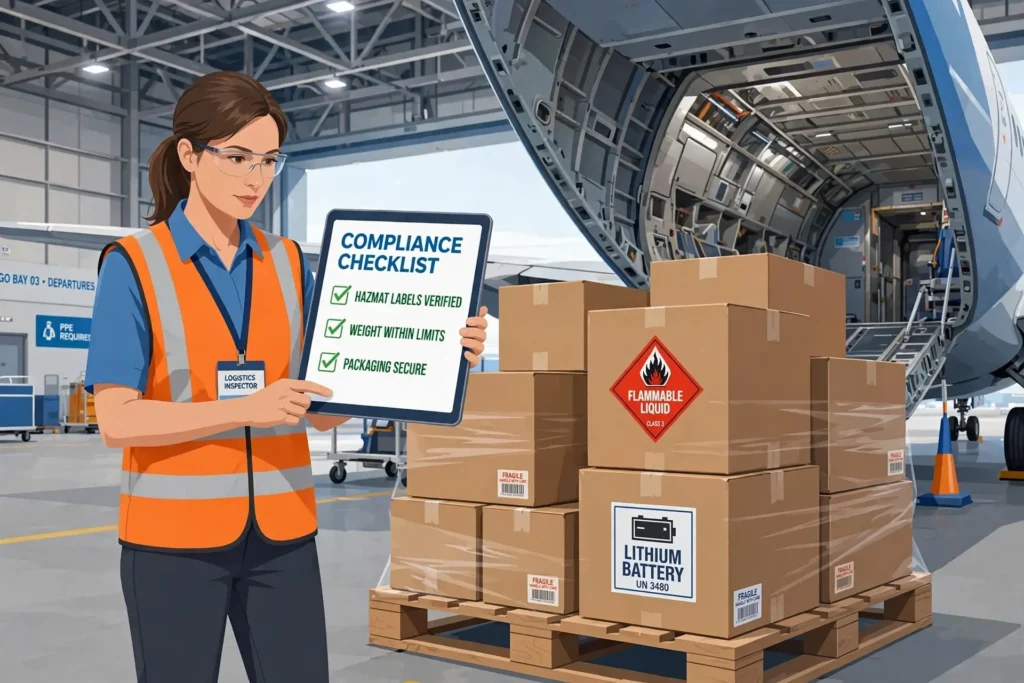
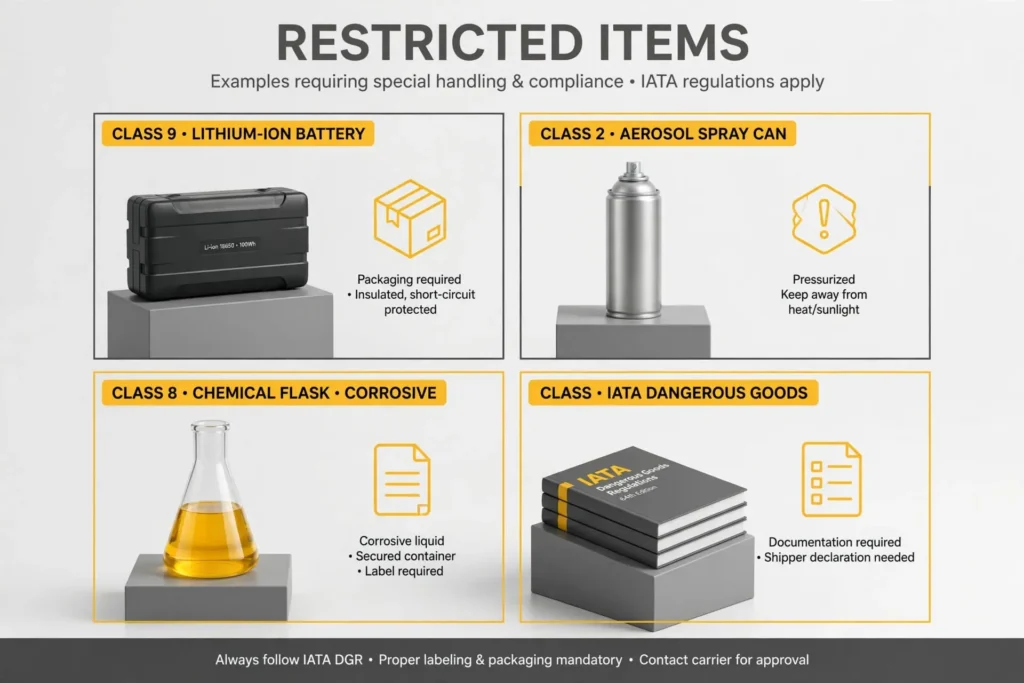
Not every product can simply be packed into a box and placed on an aircraft.
Certain goods may be classified as Dangerous Goods (DG) and are subject to specific requirements for:
- Classification
- Packing
- Marking
- Labelling
- Documentation
- Handling
- Acceptance
Examples can include certain batteries, chemicals, aerosols and other regulated materials.
The latest applicable requirements should always be checked because air-cargo regulations and standards are updated periodically. IATA notes that its Dangerous Goods Regulations are updated annually.
What Information Do You
Need for an Air Freight Quote?
Before asking for an air freight quotation, keep these details ready.
Cargo
- Product name/description
- Quantity
- Number of cartons/packages
Weight
- Gross weight
- Net weight
Dimensions
- Length
- Width
- Height
- Dimension of each package
Shipment
- Origin city/airport
- Destination city/airport
- Import or Export
- Incoterm
- Required delivery timeline
Special Requirements
- Dangerous goods?
- Battery-operated?
- Perishable?
- Fragile?
- Temperature-sensitive?
- Any special handling requirement?
The more accurate the shipment information, the more meaningful the freight quotation can be.
When Should You Choose Air Freight?
Consider air freight when:
Choose Air Freight when:
- Your shipment is urgent
- Your inventory is needed quickly
- The cargo is relatively small
- The goods have high value compared with their weight
- A delay could affect your business
- You need faster replenishment
Consider Sea Freight when:
- Your shipment is large or bulky
- The cargo is not urgent
- Transportation cost is a major consideration
- You can accommodate a longer transit time
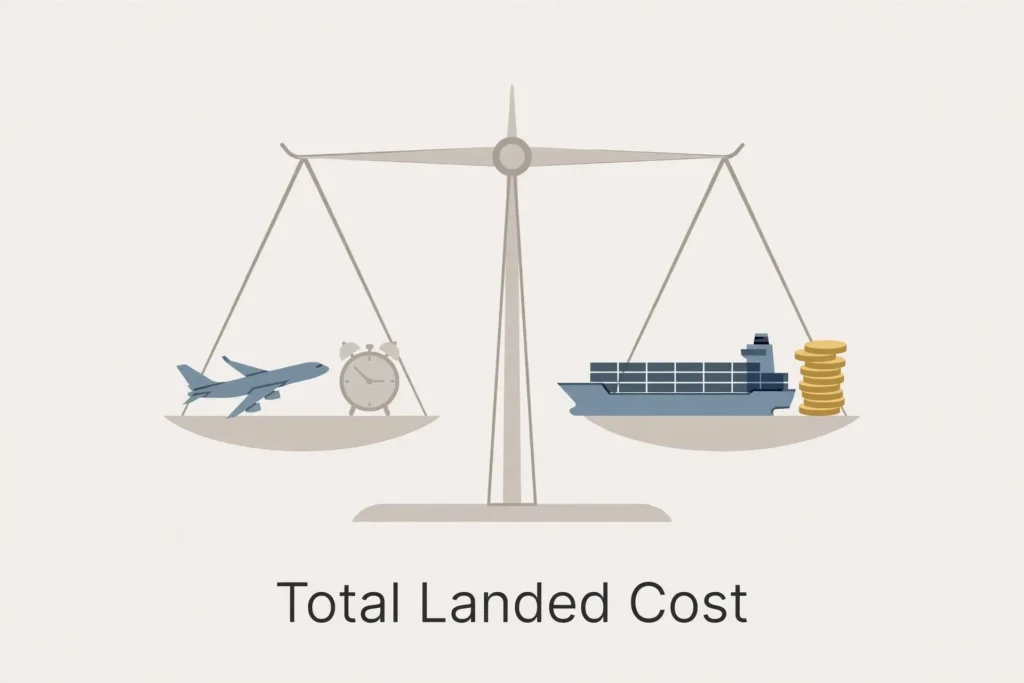
The decision should ultimately consider freight cost + transit time + cargo characteristics + total landed cost, rather than looking at the freight rate alone.
Free Freight Planning Tools
Before booking your shipment, use VSN Logistics tools to understand your requirements.
Calculate CBM
Estimate your cargo volume.Check Freight Rates
Request/check available freight pricing.
Check Transit Time
Understand the expected transportation timeline.
Check Duty Charges
Estimate applicable customs duty.
Find HS Code
Research the appropriate HS classification..
Currency Converter
Convert shipment values between currencies.
FAQs - Frequently Asked Questions
Generally, yes. Air freight is normally selected when faster transportation is more important than the lower transportation cost often associated with sea freight.
Not necessarily. Depending on the shipment, the applicable chargeable weight can be influenced by both actual and volumetric/dimensional weight.
It can be more expensive than sea freight, particularly for large or heavy shipments. However, the appropriate comparison should consider the complete logistics cost and the value of faster delivery.
An Air Waybill (AWB) is a key document in air cargo and serves as the contract of carriage between the shipper and the airline/carrier.
Some batteries can be transported by air, but restrictions and documentation requirements depend on the type of battery and shipment. Specific requirements must be checked before booking.
Some dangerous goods can be transported by air under applicable regulations, while others may be prohibited or subject to specific restrictions, packaging and documentation requirements.
Usually, you should provide the product description, quantity, number of packages, gross weight, dimensions, origin, destination and shipment terms. Additional information may be required depending on the cargo.
Choose based on urgency, cargo size, weight, value, destination and total landed cost rather than freight rate alone.

Explore Air Freight Guides
Air Freight Guide:
- Understand how international air freight works.

- Follow the shipment from booking to delivery..
- Understand the different components of air freight cost..
- Learn why a lightweight shipment can sometimes be charged by its dimensions..
- Understand the basics of regulated cargo moving by air.
- Compare both modes before deciding how to ship.
- Quick answers to common air shipping questions.
Planning an Air Freight Shipment?
Don't choose air freight simply because it is faster.:
Understand your cargo. Calculate the chargeable weight. Compare the total cost. Check the required documentation. Then choose the right shipping option. VSN Logistics — Helping Importers Plan Better Shipments.