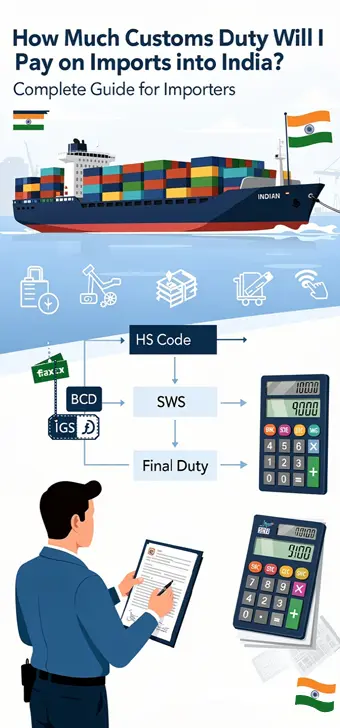
How Much Customs Duty Will I Pay on Imports into India? Complete Guide for Importers
Customs duty in India is not a fixed percentage. The amount payable depends on the product's HS code, assessable value, Basic Customs Duty (BCD), Social Welfare Surcharge (SWS), IGST, and any applicable notifications. Importers should calculate duty based on the correct product classification and current customs regulations before shipping goods into India.
Introduction
Importing goods into India can be profitable, but many businesses underestimate one critical cost: customs duty.
A common question asked by first-time importers, SMEs, e-commerce sellers, and procurement teams is:
The answer is not always straightforward. Customs duty in India depends on multiple factors including the product category, HS code classification, country of origin, freight cost, insurance value, and applicable government notifications.
Many importers focus only on product cost and freight charges, only to discover additional duties, taxes, and regulatory costs after the shipment arrives.
Understanding how customs duty is calculated helps businesses:
Estimate landed costs more accurately
Avoid budgeting surprises
Prevent customs disputes
Plan imports more effectively
This guide explains the customs duty calculation process in India, the major duty components involved, common importer mistakes, and practical examples to help you understand what to expect before shipping.
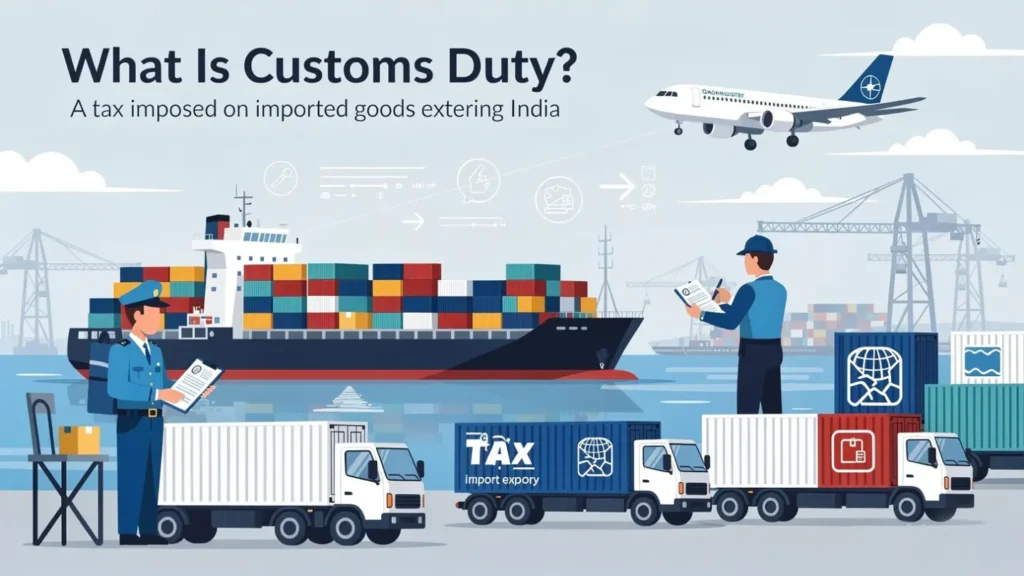
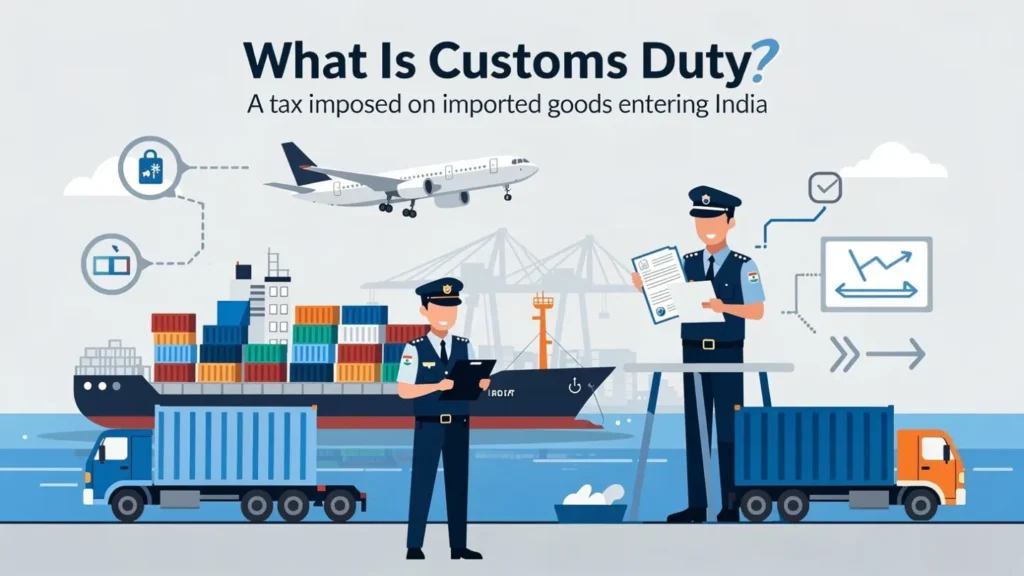
What Is Customs Duty?
Customs duty is a tax imposed by the Government of India on imported goods entering the country.
The purpose of customs duty includes:
Generating government revenue
Protecting domestic industries
Regulating imports
Managing trade policies
Supporting national economic objectives
Whenever goods enter India through a seaport, airport, ICD, or land border,
customs authorities assess the shipment and determine applicable duties and taxes.
Import cargo undergoing customs assessment at an Indian port
Customs officers reviewing import documentation for international shipments
Customs clearance process and final delivery of imported goods from port to warehouse in India.
Who Pays Customs Duty?
Generally, the importer of record is responsible for paying customs duty.
This may include:
Manufacturers
Traders
Distributors
E-commerce sellers
Corporate importers
First-time importers
Customs clearance cannot usually be completed until applicable duties and taxes are paid.
Is Customs Duty Applicable on Every Import?
Most commercial imports attract customs duty. :
However, the actual amount depends on:
Product classification
Government notifications
Trade agreements
Exemptions
Special schemes
Duty rates can vary significantly between product categories.
Main Components of Import Duty in India
Import duty is not a single tax.
Several components may apply depending on the shipment.
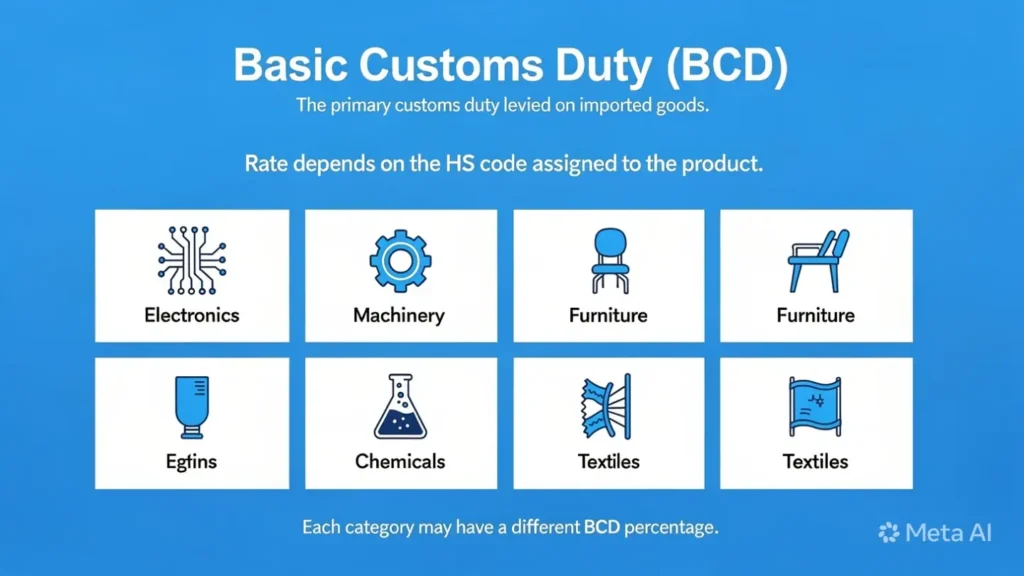
Basic Customs Duty (BCD)
Basic Customs Duty is the primary customs duty levied on imported goods. :
The rate depends on the HS code assigned to the product.
Examples
Electronics
Machinery
Furniture
Chemicals
Textiles
Each category may have a different BCD percentage.
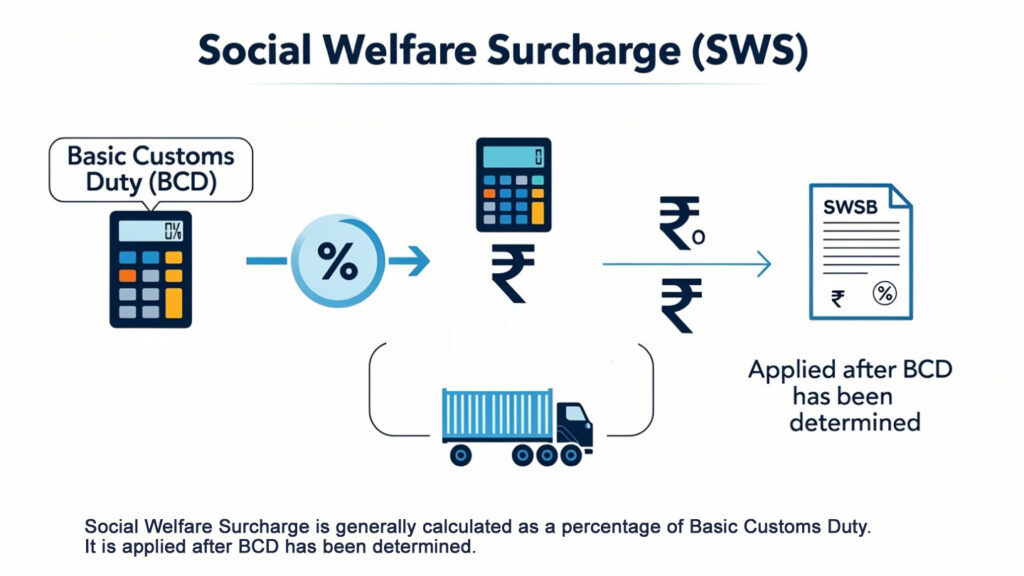
Social Welfare Surcharge (SWS)
Social Welfare Surcharge is generally calculated as a percentage of Basic Customs Duty.
It is applied after BCD has been determined.
Integrated Goods and Services Tax (IGST)
IGST is charged on imports similarly to GST applied within India.
It is calculated on a value that includes:
Assessable value
Basic Customs Duty
Social Welfare Surcharge
For GST-registered businesses, IGST may be eligible for input tax credit, subject to applicable regulations.
Illustration showing Basic Customs Duty, IGST, and import tax components in India
Import container shipment with customs duty and tax calculation concept
International cargo arriving at an Indian seaport for customs clearance
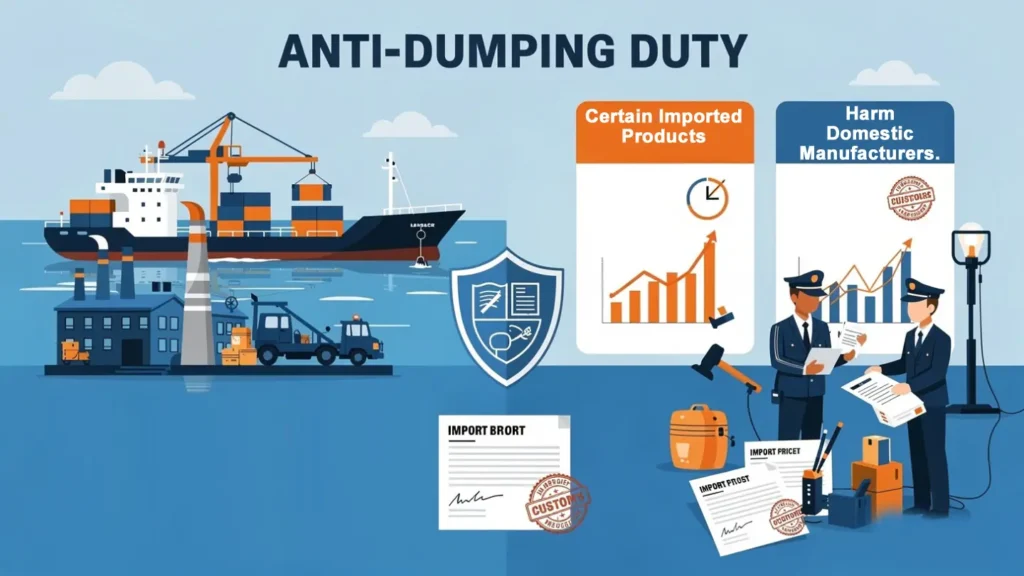
Anti-Dumping Duty
Certain imported products may attract anti-dumping duty.
This is imposed when imported goods are sold at unfairly low prices that may harm domestic manufacturers.
Not all products are subject to anti-dumping duty.
Safeguard and Special Duties
In specific circumstances, additional duties may be imposed to protect domestic industries or address trade-related concerns.
These are product-specific and notification-driven.
What Is Assessable Value?
One of the most misunderstood concepts in importing is assessable value.
Many importers assume customs duty is calculated only on the product cost.
This is incorrect.
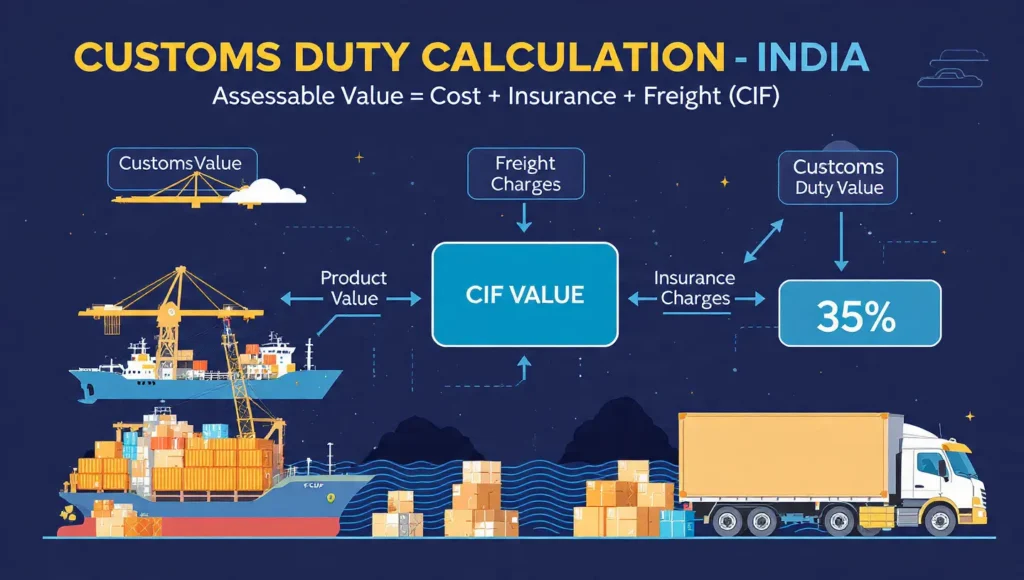
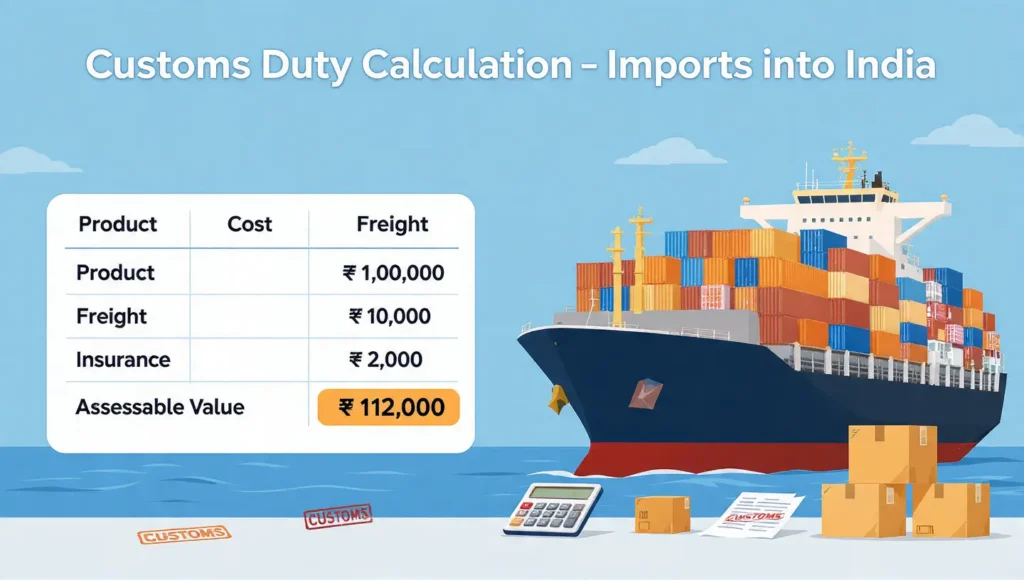
Customs duty is generally calculated on the assessable value of the shipment.
The assessable value usually includes:
These are product-specific and notification-driven.
Product value
Freight charges
Insurance charges
This is commonly referred to as the CIF value:
Cost + Insurance + Freight
The assessable value forms the foundation for customs duty calculations.
Anti-dumping duty assessment on imported goods entering India
Assessable value calculation for imports into India including product cost freight and insurance CIF value for customs duty calculation
How customs duty is calculated in India using assessable value based on cost insurance and freight CIF value
Why HS Code Classification Is Critical
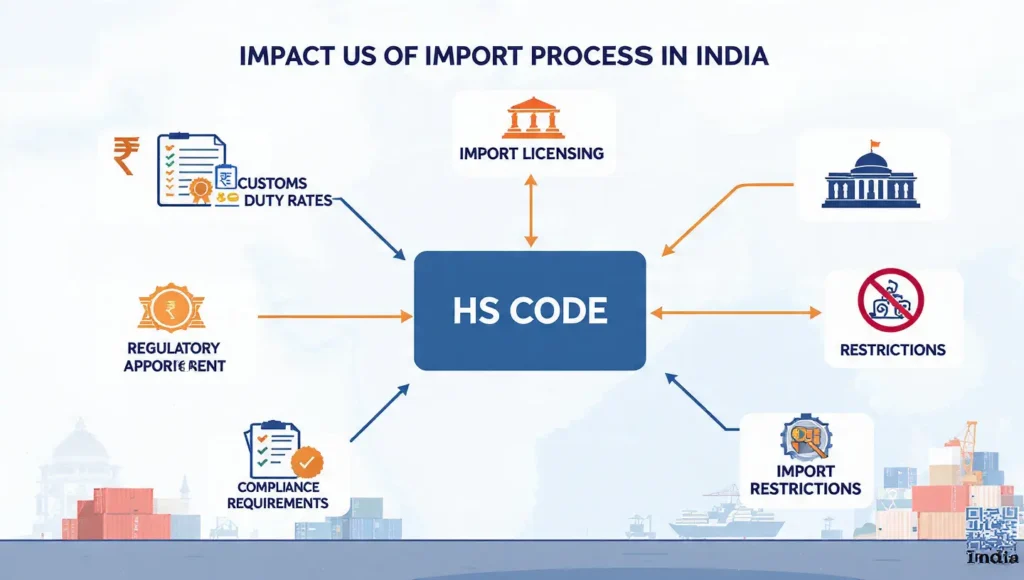
Every imported product must be classified under a specific HS code.
HS stands for Harmonized System.
The HS code determines:
Duty rate
Regulatory requirements
Licensing obligations
Import restrictions
Compliance requirements
Incorrect HS Classification Can Increase Costs
A wrong HS code may result in:
HS stands for Harmonized System.
The HS code determines:
Incorrect duty payment
Customs reassessment
Shipment delays
Penalties
Additional scrutiny
Importers should verify product classification carefully before shipment.
Customs Authorities Can Reassess Classification
Even if an importer declares a particular HS code, customs authorities may review the classification and assign a different code if necessary.
This can affect the final duty payable.
HS code classification for imported products in India used to determine customs duty rates and import compliance requirements
Customs officer verifying HS code classification for imported cargo during customs clearance process in India
HS code determines customs duty import regulations licensing requirements and compliance obligations in India
Example of Customs Duty Calculation
Custom duty calculation formulas remain structurally fixed, while the specific percentage rates, exemptions, and valuation thresholds are updated by governments periodically (often during annual budgets).
1. Determine Assessable Value
The base amount used for all calculations is the Assessable Value (AV), also known as the Customs Value. It uses the Cost, Insurance, and Freight (CIF) model.
AV = Value of Goods + Cost of Insurance + Cost of Freight
2. Apply the Sequential Formulas
Step A: Basic Customs Duty (BCD)This is the primary tax levied on the goods. The percentage (r_BCD) varies by product type.
BCD = AV x r_BCD
Step B: Social Welfare Surcharge (SWS)
This is a secondary tax calculated as a fixed percentage (r_SWS), usually 10%) of the BCD amount, not the Assessable Value.
SWS = BCD x r_SWS
Step C: Integrated Goods and Services Tax (IGST)
IGST is applied to the cumulative value of the goods,
including all previous customs duties. The rate (r_IGST) depends on the domestic tax
bracket of the item.
IGST Value Base = AV+BCD+SWS
IGST = (AV+BCD+SWS) x r_IGST
3. Total Custom Duty Formula
To find the total duty payable to the government,
add all the calculated duty components together.
Total Duty = BCD + SWS + IGST
4. Dynamic Components vs. Fixed Structure
Component
Status
How It Changes
Formula Architecture
Fixed
The sequence of adding BCD and SWS before calculating IGST
does not change over the years.
Duty Rates (rBCD, rIGST)
Dynamic
Governments change these percentages annually based on
trade policies and domestic production needs.
Exchange Rates
Dynamic
Customs authorities update official currency conversion
rates bi-weekly or monthly.
Total Custom Duty
Total Custom Duty Payable = BCD + SWS + IGST
The mathematical structure of compounding taxes remains constant over time, ensuring predictability in trade logistics while allowing governments fiscal flexibility.
Importer Exporter Code registration and supplier agreement process for importing goods into India.
International freight transportation of goods to India via sea and air cargo.
Customs clearance process and final delivery of imported goods from port to warehouse in India.
Common Mistakes Importers Make
Many importers pay more than expected because of avoidable mistakes.
Using Incorrect HS Codes
Wrong classification can lead to:
Incorrect duty estimates
Customs objections
Delays
Ignoring Freight and Insurance
Customs duty calculations generally consider CIF value, not just product cost.
Relying on Outdated Duty Information
Government notifications and customs regulations can change.
Duty assumptions based on old data may be inaccurate.
Underestimating Landed Cost
Duty is only one part of landed cost.
Importers should also consider:
Port charges
Documentation fees
Transportation
Storage
Compliance expenses
Does Customs Duty Change Over Time?
Yes.
Duty rates are not permanent.
Changes can occur due to:
Union Budget announcements
DGFT notifications
Trade agreements
Industry protection measures
Economic policy decisions
Importers should verify current duty structures before every shipment.
Can Customs Authorities Change Declared Values?
Customs authorities may review declared values if they believe the declared amount does not reflect transaction value or market conditions.
Additional documentation may be requested to support valuation.
Importers should maintain accurate invoices, contracts, payment records, and supporting documents.
How a Freight Forwarder Helps
with Duty Planning
Although customs authorities determine final assessments, freight forwarders help importers prepare more effectively.
A freight forwarder may assist with:
Documentation review
HS code guidance
Freight cost planning
Import process coordination
Customs clearance support
Landed cost estimation
Proper planning before shipment can significantly reduce unexpected costs and delays.
Frequently Asked Questions (FAQs)
Custom Duty in India before Importing your Goods
Yes. Estimated duty calculations can be prepared before shipment based on product classification and available regulatory information.
Duty calculations generally consider the assessable value, which typically includes product value, freight, and insurance.
For eligible GST-registered businesses, IGST paid on imports may be available as input tax credit, subject to applicable regulations.
Incorrect classification may result in reassessment, delays, penalties, or additional duty liability.
No. Duty rates may change due to government notifications, trade policies, or regulatory amendments.
Key Takeaways
Although customs authorities determine final assessments, freight forwarders help importers prepare more effectively.
A freight forwarder may assist with:
Customs duty in India is not a fixed percentage for all products.
The correct HS code plays a major role in determining duty liability.
Assessable value generally includes product cost, freight, and insurance.
Import duty may consist of BCD, SWS, IGST, and other applicable duties.
Government notifications can change duty structures over time.
Accurate planning helps importers estimate landed costs more effectively.
Customs assessments are case-specific and final decisions rest with customs authorities.
Conclusion
Understanding customs duty is essential for every importer. Whether you are importing machinery, electronics, furniture, textiles, or consumer goods, accurate duty estimation helps improve budgeting, pricing, and overall supply chain planning.
The most successful importers focus not only on product cost but on the complete landed cost of bringing goods into India. By understanding customs duty components, HS code classification, and compliance requirements, businesses can reduce uncertainty and make more informed importing decisions.